Writing an Essay for William Blake's Chimney Sweeper for CIE Literature
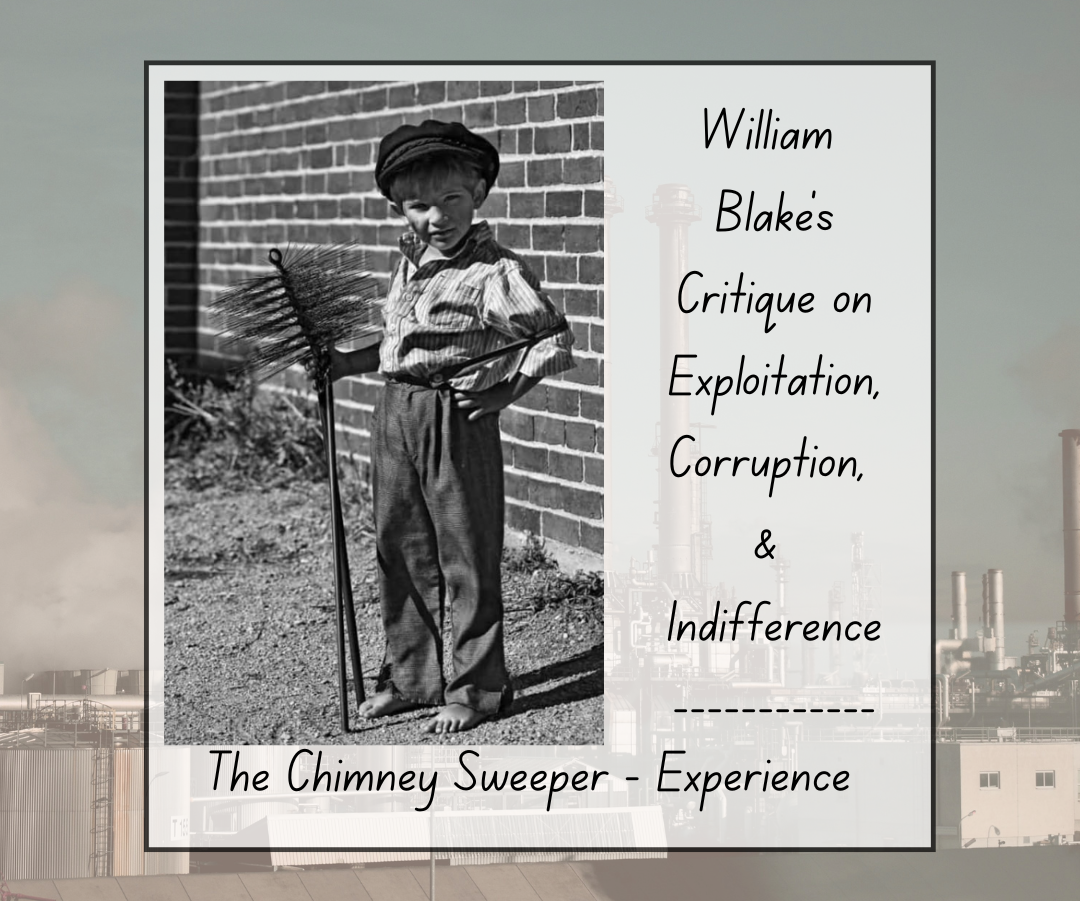
Blake's 'The Chimney Sweeper' from Songs of Experience, which is in Songs of Ourselves Volume 1, is far more bitter and politically charged than many students initially realise. In the poem, the child – who is the speaker – is not comforted by false hope or religious promises.
There is another poem with the same name, 'Chimney Sweeper' in Songs in Innocence from the same collection, in which the child innocently accepts of unfairness of his life. But in this poem, the child understands the hypocrisy which surrounds him.
From the opening image we get from the first line,
"A little black thing among the snow",
Blake immediately creates a harsh contrast between the innocent child who deserves warmth, and the corrupted surroundings which refuses him comfort. So we see how the child is isolated inside a cold, uncaring society.
For IGCSE students, the poem is to be understood completely. However, Blake makes this easy for us by compressing the poem into three clear stanzas that speak of enormous ideas that you can analyse in depth. These ideas are:
- child exploitation,
- corrupted innocence, and
- society's ability to normalise suffering
Theme 1: Child Exploitation
In eighteenth-century England, poor children were often forced into dangerous labour, and chimney sweeping was one of the most brutal jobs imaginable. Small boys were sent into narrow chimneys where many became sick and injured, or even died from exhaustion and disease.
In the poem, the child is reduced to a "thing", almost stripped of humanity and dignity by the labour forced upon him. Is this how children are supposed to live? Or are children supposed to live a life filled with wonder and play in your opinion? Blake suggests that exploitation does not merely harm children physically: it erases their identity and innocence completely.
Lines that highlight this theme:
- "A little black thing among the snow"
- Crying "weep! 'weep!" in notes of woe!
- "taught me to sing the notes of woe"
While analysing these lines, think about why Blake might have written this poem, and who he may be blaming through this piece of social commentary.
Theme 2: Corrupted Innocence
Blake deliberately contrasts images of freedom and joy with images of suffering to show how society has the ability to corrupt what should have been a happy and natural childhood. The child remembers being "happy" and "smiling", and then the child says something shocking:
They clothed me in the clothes of death
The child is letting us know how suffering has been forced upon him. Blake implies that innocence is not simply lost naturally with age. Sometimes, it is actively destroyed by the systems surrounding the child.
Lines that highlight this theme:
- "Because I was happy upon the heath"
- "and smil'd among the winter's snow"
- "because I am happy and dance and sing"
- "They clothed me in the clothes of death"
The most disturbing part of the poem is now emotionally aware the child seems to be. He understands that the adults around him are supposed to do something but fail to help him in any way. Blake therefore presents innocence as something to be protected, since it is fragile and can easily be exploited or corrupted by society.
Theme 3: Society's Ability to Normalise Suffering
The poem also shows us how easily society might accept the suffering of children as something ordinary. Blake makes it clear that exploitation happens not simply because people are cruel, but because they have convinced themselves that no real harm is being done – they become indifferent to the suffering. The child bitterly observes:
because I am happy and dance and sing,
They think they have done me no injury.
The verb "think" is important here. The child is saying adults are almost deceiving themselves with their willful ignorance. They judge the wellbeing of these children through lenses formed by their own comfort.
Lines that highlight this theme:
- "They are both gone up to the church to pray"
- "And are gone to praise God and his Priest and King"
- "Who make up a heaven of our misery"
- "They think they have done me no injury"
Blake presents this as a wider social failure rather than an individual one. Parents, the Church, and political authority are all implicated in maintaining this system. According to Blake, these figures present themselves as righteous but somehow benefits from ignoring the misery of the vulnerable society who are living alongside them.
Other Poems in this Collection
 Sweety Isaac
 Sweety Isaac
 Sweety Isaac